Adaptive Management Plan, 2006
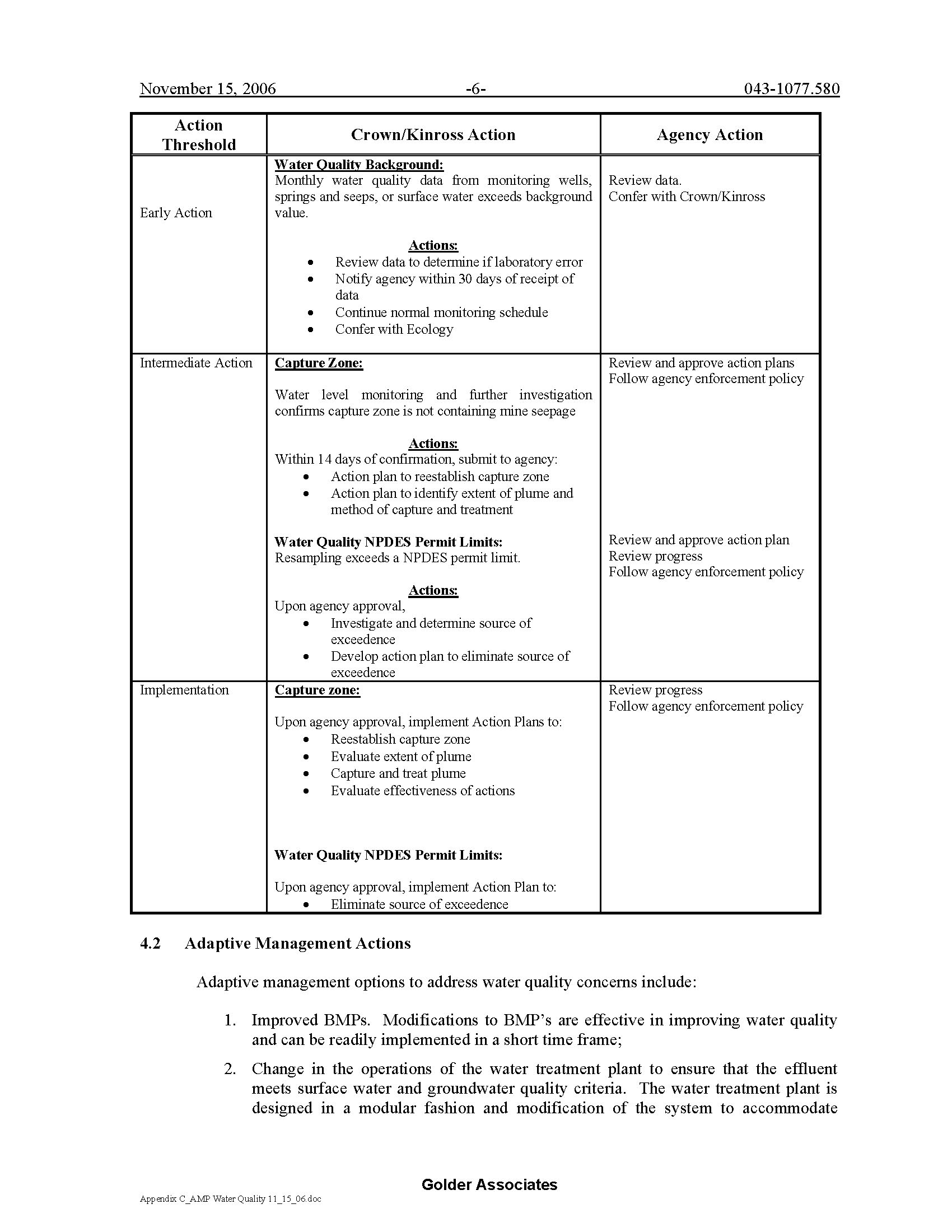
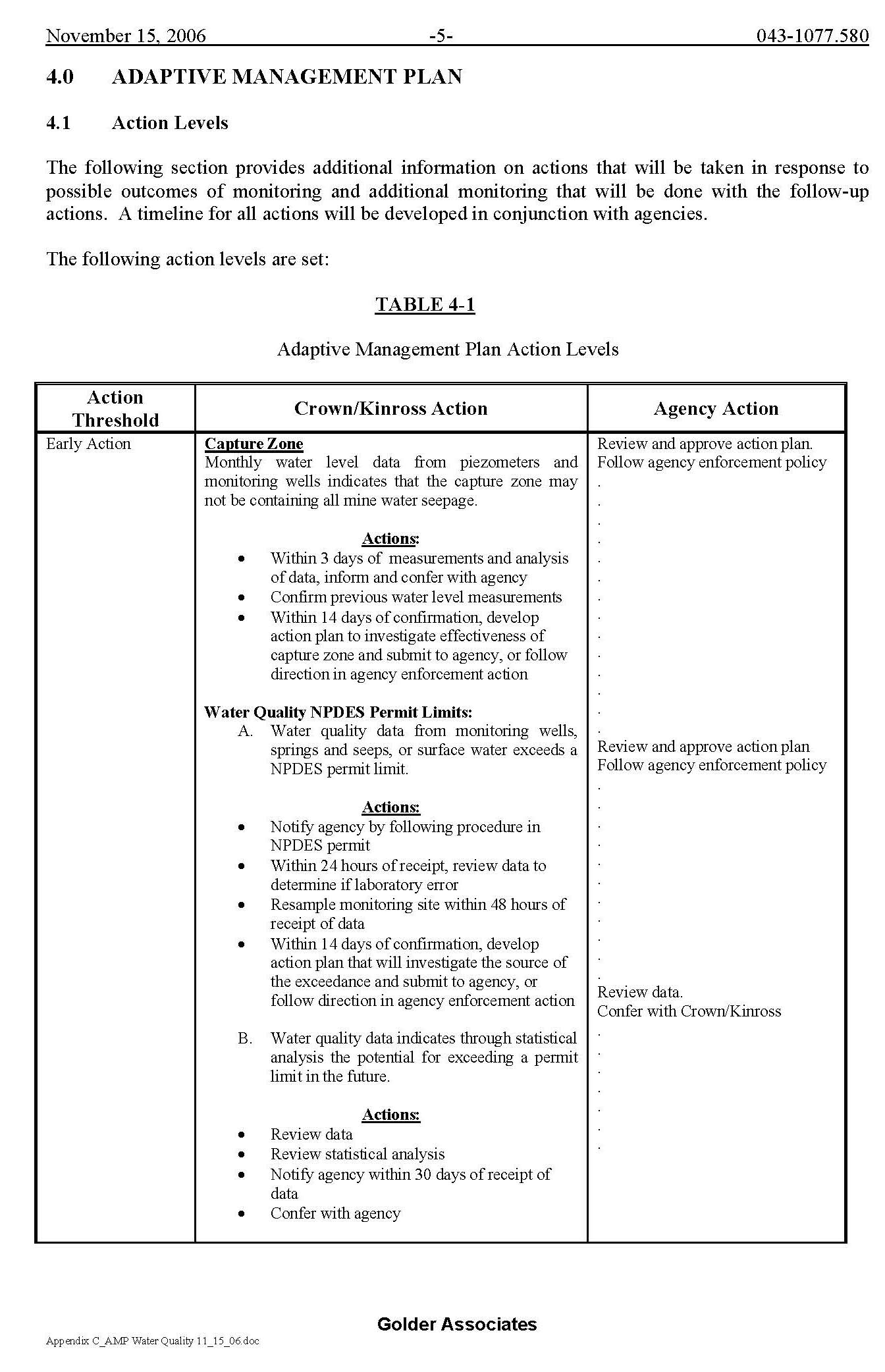
According to the mine’s original Adaptive Management Plan (AMP), the water quality problems at the mine should trigger specific actions. The steps are clearly outlined, requiring the company to: notify Ecology, identify the source of the contaminants and the extent of the plume, and develop a plan to remediate the problem. Over the years, various levels of investigation have provided useful data to help in the search for the contaminant flow path. Likely culprits have been identified, such as surface water from mine facilities, development rock stockpiles, and the underground mine workings. Collecting monitoring data in the appropriate locations, such as below the development rock stockpile, is critical to understanding the source of the water quality problems.
Phases of Adaptive Management
Adaptive Management details include an action threshold and indicate who would take what action. The specific plans have three phases:
- Phase I (early action) based on 50% of predicted impact: Kinross would review data and determine the likelihood predicted impacts would be exceeded. If they think there would be a potential for greater impacts they would inform the agency in their annual report. Take voluntary action and continue monitoring. The agency would take no action.
- Phase II (planning) based on 80% of predicted impact: If Kinross decides monitoring suggests impacts would exceed predictions, they would then develop a Contingency Plan. The agency would meet with Kinross and develop a plan.
- Phase III based on 100% of predicted impact: Kinross would implement Contingency Plan. The agency would oversee contingency actions.
Below are examples from the Adaptive Management Plan, stating what actions will be taken if water quality data show parameters exceeding background values. Although levels have exceeded background since mining began, these adaptive management steps have not been followed.
Ongoing AMP Issues
Kettle River Tailings Facility
There was a trend of increasing concentrations of nitrate, sulfate, and TDS in surface water; this should require Adaptive Management Plan action.
Issues with the Supplemental Environmental Impact Statement AMP
One of the major flaws in Ecology’s Supplemental Environmental Impact Statement (SEIS) was its reliance on adaptive management or more accurately a plan that is titled adaptive management but in reality has poor mechanism to adapt to changing situations. It would be more accurately be characterized as a monitoring plan. Adaptive management should be an active systematic process for continually improving management policies and practices by sequential learning from the outcomes of operational programs. It should be designed to experimentally compare selective policies or practices by evaluating alternative hypotheses. Ecology and Kinross want to redefine adaptive management and use it as a basis for the entire mine plan.
To put this plan in perspective, Ecology relied on this adaptive management plan for most aspects of the mine proposal including:
- Dewatering impacts to seeps and springs
- Dewatering and water supply impacts to steamflow
- Fine sediment deposition and water quality changes to Marias Creek from the mine access road
- Aquatic habitat improvements to mitigate for streamflow impacts from mine dewatering
- Development rock management
- Water treatment plant operations
- Upland habitat protection, enhancement and management
- Wildlife management along haul road
- Kettle river tailings impoundment
The AMP was relied on to evaluate the monitoring data and compare it to what is predicted in the SEIS and to evaluate compliance to the requirements of various permits including:
- The NPDES for the collection, treatment and discharge of mine water,
- The water rights for the use of surface water and ground water supply and mitigation,
- The construction and operational stormwater,
- The hydraulic permit approval for the construction and maintenance new culverts and stream restoration,
- The permits on National Forest Land,
- The waste discharge and Dam Safety for the tailings impoundment